The Global Legal Post: Global M&A – Cyprus chapter

Click here to read the full chapter.

Our Partner, Christina Ioannidou authored the Cyprus Market Insights chapter “Banking consolidation and the dawn of transformational mergers and acquisitions in Cyprus”, to the Global M&A Law Guide by The Global Legal Post, offering a comparative view of the legal frameworks behind today’s transactions.

“Cyprus has entered a new era of M&A: one defined by deals of genuine transformational complexity. The past year has seen successful completion of cross-border transactions, multi-layered banking and insurance consolidations, infrastructure project finance, and rigorous antitrust proceedings. The Eurobank-Hellenic Bank merger alone, at €1.3 billion and spanning multijurisdictional regulators, mandatory bids, squeeze-out, parallel listings and reorganisation, is proof that Cyprus has the legal infrastructure, regulatory sophistication and professional expertise, befitting a leading European M&A hub. My chapter in the Law Over Borders Global M&A Guide captures what this shift means in practice, and what it signals for the transactions ahead.” Christina Ioannidou


The Nicosia Declaration: Key implications for the maritime industry

The Nicosia Declaration on Enhancing Seafarers’ Education and Promoting Women’s Inclusivity in the Shipping Industry was adopted today by EU Maritime Affairs Ministers in Nicosia, signalling a clear and collective European commitment to placing the human element at the centre of the shipping industry’s future.

The Declaration was the central item at the Informal Transport, Telecommunications and Energy Council meeting on maritime affairs. It aims to modernise maritime education and training by focusing on the upskilling and reskilling of seafarers, technology-driven education, workforce safety, women’s participation in the industry, and raising awareness of careers in shipping.

Why It Matters

The Nicosia Declaration shapes what comes next for European maritime policy.

The EU Industrial Maritime Strategy, adopted by the European Commission on 4 March 2026, sets out a comprehensive framework for the sector built around three pillars: ‘Build, Equip and Repair’, ‘Transport and Connect’, and ‘Secure and Protect’. Skills development sits as a horizontal initiative cutting across all three. The Nicosia Declaration, backed by all EU Member States, gives that skills agenda direct political weight. In practical terms, when the Commission advances legislative proposals or funding programmes on maritime workforce development, Ministerial-level backing of this kind strengthens the case for action and increases the likelihood of those proposals moving forward.

For shipping lawyers, the most immediately relevant consequence of the Declaration is the pressure it creates on the ongoing overhaul of the International Convention on Standards of Training, Certification and Watchkeeping for Seafarers (STCW). The IMO’s Sub-Committee on Human Element, Training and Watchkeeping (HTW) has identified more than 400 gaps in the existing STCW framework, and the comprehensive review currently underway, the most ambitious since the 1978 STCW Convention was adopted, addresses digitalisation, decarbonisation, seafarer well-being, and skills development. A full revision is targeted for completion by 2027. A declaration of this kind increases the political pressure to ensure that revision is ambitious and future-facing.

The priorities to monitor are: the evolution of EU rules on maritime training and certification; the development of diversity and inclusion requirements for flag State administrations and ship operators; and the integration of maritime workforce standards into broader EU sustainability frameworks. Underlying all of this is a point that the Declaration makes plainly: the seafarer remains the foundation of everything. From crew agreements governed by the Maritime Labour Convention 2006, to certification obligations under STCW, to flag State duties under SOLAS, each of these frameworks ultimately centres on the people on board.

When policy moves at this level, it eventually finds its way into the contracts, disputes and compliance questions that define day-to-day practice in the industry.

If you have questions about how these developments may affect you, the shipping team at Ioannides Demetriou LLC would be happy to assist. Email us here.

Our Latest Contributions to Legal 500: Cyprus Project Finance & Real Estate

We are pleased to highlight two recent contributions by our team to the Legal 500 Country Comparative Guides, covering key aspects of the hashtag#Cyprus legal landscape.

➡️ Cyprus Project Finance. Contributors: Partners Christina Ioannidou and Katerina Hadjichristofi.
🔗https://www.legal500.com/guides/chapter/cyprus-project-finance/?export-pdf

➡️ Cyprus Real Estate. Contributors: Partner Demetris Kronides and Senior Associate Elias Demetriou.
🔗 https://www.legal500.com/guides/legal-landscapes/cyprus-real-estate/?export-pdf

These country-specific Q&As provide practical insights on structuring projects and property investments through SPVs, key financing and security considerations, the regulatory framework, financing and considerations for foreign investors in the Cyprus market.

Employee Share Option Schemes in 2026: From Incentive Tool to Strategic Imperative

We are currently observing a fundamental shift in how value is created within modern businesses. Artificial intelligence (AI) is transforming industries and automating processes that were once performed by large teams. As businesses become increasingly knowledge driven, value is concentrated in fewer individuals who design systems, supervise technology and make strategic decisions. In this environment, each key person carries greater responsibility and influence over long term growth.

An Employee Share Option Scheme (ESOP) enables a company to grant selected employees the right to acquire shares in the company at a predetermined exercise price. The grant of an option does not result in immediate share ownership. Instead, the right to acquire shares becomes exercisable over time, typically following a defined vesting period and, where appropriate, subject to performance conditions. Vesting may be time based, performance based through measurable Key Performance Indicators, or structured as a combination of both. In legal and commercial terms, an ESOP operates as a deferred equity participation mechanism through which companies can align key individuals with the future value of the business.

The effectiveness of such a scheme depends entirely on its structure. A formal plan must be adopted at the appropriate corporate level, clearly defining eligibility, vesting conditions, exercise mechanics and leaver provisions. A specific pool of shares should be reserved out of the company’s authorised capital for the purposes of the scheme, and the board of directors must be expressly eauthorised to administer and regulate its operation. Exercise opportunities may be confined to defined periods to manage governance considerations, while maintaining flexibility for liquidity events such as an initial public offering or corporate exit. Each participant should enter into a separate option agreement governed by the overarching plan, and good leaver and bad leaver provisions require balanced drafting to protect corporate stability without undermining commercial fairness.

The importance of employee equity participation has now been recognised at policy level. As part of the 2026 tax reform in Cyprus, effective from 1 January 2026, benefits derived from approved ESOPs are subject to a flat 8 percent tax rate, provided specific statutory conditions are satisfied. These include a minimum three-year vesting period, non transferability and a minimum exercise price of at least 50 percent of market value at the time of approval.  The scheme must relate to shares of the employer or its affiliated companies, and any shares issued under the scheme must bear the same rights as the issuing company’s other ordinary shares, with the exception of voting rights. The preferential rate applies up to twice the employee’s annual remuneration at the year of vesting. The benefit applies up to the amount of one million euro over a ten-year period with any excess taxed at standard progressive rates.

Companies with existing or proposed employee share option schemes should note that they have the right to get the benefits of the new tax scheme provided that they utilize the transitional period for submitting qualifying plans to the Tax Commissioner for approval by 30 June 2026. Timely review is therefore essential.

Early engagement with professional advisors can help ensure that plan documentation, vesting schedules and other requirements align with the statutory criteria for the preferential 8% tax regime. We are available to advise on qualification criteria, draft and implement ESOP documentation, assist with the approval process and provide ongoing guidance on legal and tax compliance in this evolving landscape.

Authors: Zoe Christou, Director, Ioannides Demetriou LLC and Michalis Eleftheriou, Director, Nobel Trust Ltd

Skip the noise. A 3-minute expert view on Cyprus’ tax reform.

Nayia Morphi cuts through the noise with a clear, brief expert view on Cyprus’ latest tax reform. Beyond the headline rate increases, she explains why many of the changes were inevitable, why several of them are genuinely positive, and how the reform enhances Cyprus’ credibility as a modern, predictable and competitive international business centre. With a focus on substance over headlines, the commentary highlights where the system has been simplified, where incentives have been strengthened, and what businesses, investors and individuals should actually pay attention to.

Corporate tax: rate increases from 12.5% to 15%.

– At first glance, the increase in the corporate tax rate from 12.5% to 15% may look like a setback. We see it differently, and we welcome it. This change was inevitable and it reflects the country’s deliberate alignment with global best practices, particularly the OECD Pillar II framework – an outcome that was widely anticipated and, in many respects, unavoidable. I view this as an improvement in the image of Cyprus as a reliable and predictable International Business Center. As far as the financial and other consequences of this amendment are concerned, these are compensated by important additional amendments like the abolition of stamp duty, the extension of the tax losses carryforward, the reduction in the dividend taxation and the enhancement of the R&D scheme.

Corporate tax: loss carryforward extended from 5 to 7 years.

– A clearly fairer measure which can be of great assistance to startup businesses which usually face significant tax losses at the beginning of their operations. So, good news! Businesses are now able to enjoy a longer extension of tax losses towards their taxable income and therefore reduce their tax bill for an extended period.

Corporate tax:  20% super-deduction for qualifying R&D expenditure is extended to 2030

– This is excellent news!  The 20% super-deduction further reduces the royalty income subject to tax until tax year 2030.

Corporate tax: gains from Crypto taxed at the flat rate of 8%.

– Crypto gains have been on the spotlight and under scrutiny for a long time. The introduction of a fixed tax rate on gains is another advantageous provision which settles the dust, brings clarity and creates certainty. All this at a time where alternative investments are on the rise. With regulation on digital assets being discussed and, in the pipeline, such an amendment could properly structure investments in crypto via Cyprus based structures at a favorable tax rate.

Corporate tax: deemed dividend distribution is abolished.

– At last, this complicated and non-commercial mechanism comes to an end!  A company is no longer forced to distribute 70% of its profits to the shareholders but can proceed with reinvestment without penalization. An absolutely fair measure which shall contribute to the development of companies and reinvestment while minimizing overcompliance and bureaucracy!  

Corporate tax: interest income received by Cyprus tax resident companies only taxable under income tax.

– It was always confusing to have two forms of tax under which interest income was taxed.  The decision was based on the nature of the income. This is now gone and it’s another form of simplification in an already advantageous tax system.

Stamp duty tax: fully abolished!

– Another complication and ambiguity removed!  The payment of stamp duty was debatable for years and as it was a kind of “self-assessment” tax, often it was either omitted or avoided in unorthodox ways with high penalty and compliance risks.  Its abolition is great news and another ode to simplicity and fairness!

Capital Gains Tax: extension of the definition of “property”

– The new definition includes shares in companies that own, directly or indirectly, shares in other companies whose asset base consists of immovable property by 20%. This amendment was a necessity to eliminate tax avoidance practices and tax capital gains resulting from immovable property. Let’s not forget that capital gains tax applies only on disposals of immovable property located in Cyprus only.  All other forms of capital gains in disposing of other kinds of assets are completely tax free!  

Personal tax: Increase of tax free income to Euro 22,000, extension of income tax bands and introduction of tax deductions to support families

– Lower taxation for all employees is always a positive development and one that helps with a more transparent declaration of employment income and a reduction in tax evasion. The amendments can lead to tax saving up to Euro 1585 for individuals.  Time to reinvest the saving into your provident or pension plan!

The additional deductions represent more of a social measure to support families of lower income in their day-to-day life and essential household needs.

Personal tax: Employee share options schemes – Benefit-in-Kind taxed at 8% (T&C apply)

– Employee share option schemes are becoming a norm in tech and other companies which develop super-fast. Cyprus’ tax system was never geared towards such kind or more progressive forms of remuneration and ownership. It was about time we did so!  Both the clarity on what an employee share option scheme is and the low taxation of 8% are absolutely awesome news which will create new possibilities for mega companies and not only, which are considering their European relocation.

Personal tax – Ex-gratia payments tax-free up to €200,000 anything greater is taxed at 20%

– This provision is more geared for the local market where ex-gratia payments have been a form of incentive for staff reduction in large organisations e.g. banks. The provision ends ambiguity on the tax treatment of such payments and introduces clarity and a preferential tax rate on the taxation of such income for individuals!

Personal tax: tax residency under the 60-day rule is simplified. You can be a tax resident in another country.

– This was an unnecessary condition in my view, so the amendment was another simplification to an already attractive tax residency route.  After all, where dual residency is the case, one should examine the relevant Double Tax Treaties and particularly the tie-breaker clause for clarity. Where taxation has been paid twice, relief may be claimed through the Mutual Agreement Procedure.

Personal tax: extension of the non-domicile regime from 17 to 27 years subject to a lump sum payment of Euro 250,000 for each additional 5-year period.

– HNWIs of foreign origin who have chosen Cyprus as their country of tax residency and business setup, who have been here long enough to be eligible for Cypriot citizenship, should no longer worry about losing important tax benefits e.g. zero taxation on dividend and interest income. In simple mathematics, if a taxpayer expects to earn more than €5,000,000 in dividend income over a five-year period following the lapse of the 17-year window, the option for extension is a no brainer.

Personal tax: dividend taxation applicable to Cyprus domiciled and tax resident individuals is reduced to 5% (form 17%) 

– A long-awaited and a fair adjustment in line with rates applicable in other European jurisdictions which is geared towards the Cyprus domiciled businessperson/investor. Cyprus-domiciled shareholders can now enjoy an aggregate tax of circa 20% on profits from their businesses/investments.


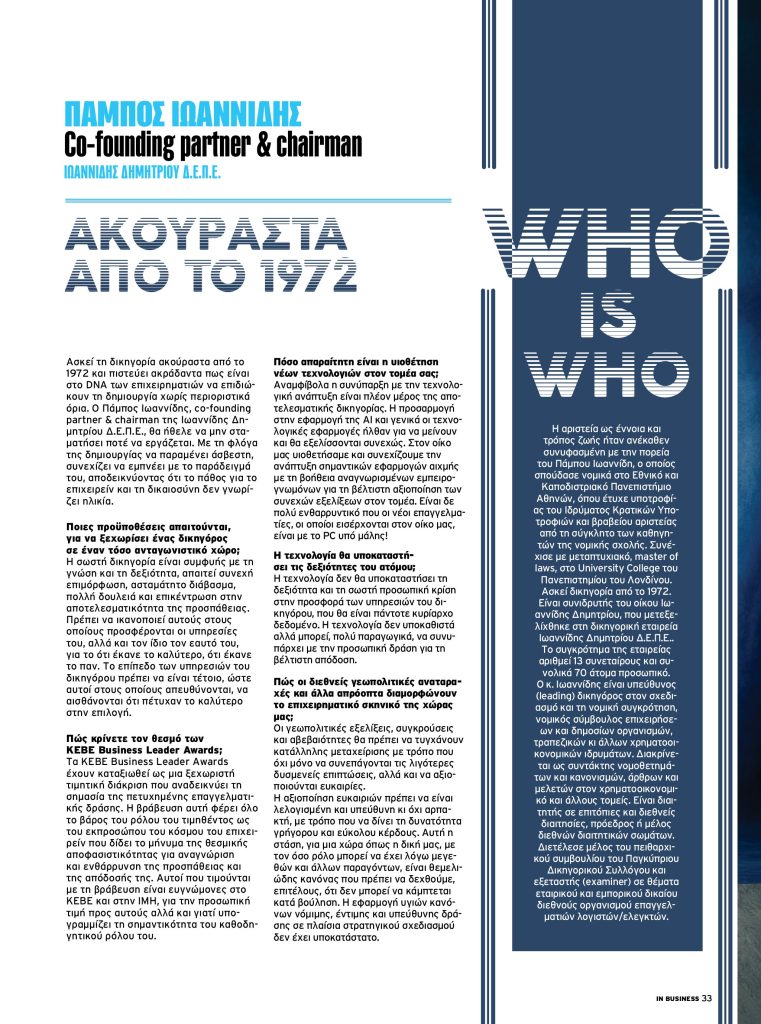
12α ΚΕΒΕ Business Leader Awards

Pambos Ioannides, IOANNIDES DEMETRIOU LLC – Ακούραστα από το 1972.

12α ΚΕΒΕ Business Leader Awards, 11 Δεκ 2025.
Συνέντευξη και WHO IS WHO στο τεύχος του περιοδικού IN Business News (Φεβ 2026).

«Ασκεί τη δικηγορία ακούραστα από το 1972. Πιστεύει ακράδαντα πως είναι στο DNA των επαγγελματικών/ επιχειρηματιών να επιδιώκουν τη δημιουργία χωρίς περιοριστικά όρια, ιδιαίτερα λόγω ηλικίας . Ο Πάμπος Ιωαννίδης, co-founding partner & chairman της Ιωαννίδης Δημητρίου Δ.Ε.Π.Ε., προσβλέπει να μην σταματήσει ποτέ να εργάζεται ‘εκτός αφεύκτως’! Με τη φλόγα της δημιουργίας να παραμένει άσβεστη, συνεχίζει να εμπνέει με το παράδειγμά του, αποδεικνύοντας ότι το πάθος για τη δημιουργία, το επιχειρείν και τη δικαιοσύνη δεν γνωρίζει ηλικία.»

Legal500 Country Comparative Guides 2026 – Cyprus Project Finance

The Legal500 Comparative Guides aim to be a valuable tool for in-house lawyers worldwide. In the 2026 guide, Ioannides Demetriou LLC Partners Christina Ioannidou and Katerina Hadjichristofi contributed to the Cyprus – Project Finance chapter. This country-specific Q&A provides an overview of project finance laws and regulations applicable in Cyprus.

Click here to view the Country Comparative Guide | Cyprus | Project Finance online

Exclusive Contributor to the Legal500 Cyprus-Real Estate Comparative Guide

December 2025: Reflecting on the evolving Cyprus real estate legal landscape and the opportunities it presents for investors, professionals, and clients alike.

The Legal500 Country Comparative Guide on Cyprus Real Estate offers an insightful snapshot of a market underpinned by a solid and transparent legal framework – one that continues to anchor investor confidence and drive growth across residential, commercial and tourism-related sectors.

As we look ahead to 2026, these insights not only reflect current trends but also help chart a course for thoughtful decision-making in an increasingly dynamic environment.

Contributors: IOANNIDES DEMETRIOU LLC Partner, Demetris Kronides and Senior Associate, Elias Demetriou.

Click here to download the Comparative Guide | Legal Landscape | Real Estate | Cyprus -Real Estate

PCAOB enters into Statement of Protocol with Cypriot Audit Regulator

Client Alert: We are pleased to highlight our firm’s direct involvement in a significant development in international audit regulation for Cyprus.

The Public Company Accounting Oversight Board of America has entered into a Statement of Protocol and a Data Protection Agreement with our Client, the Cyprus Public Audit Oversight Board, strengthening cross-border regulatory cooperation and oversight of audit firms operating in both jurisdictions. The agreements went into effect on December 15th, 2025.

This framework enhances information-sharing and coordination between regulators and reflects the continued convergence of global audit oversight standards. For companies, audit firms, and market participants with cross-border footprints, these developments have practical implications for compliance, inspections, and regulatory engagement.

Our firm advised our Client on all aspects of the Statement of Protocol and the Data Protection Agreement, including regulatory, legal drafting and data protection considerations. We are proud to contribute to initiatives that promote regulatory certainty, investor protection, and high-quality audits in global capital markets.

The official announcements can be found at the links below:

Public Company Accounting Oversight Board PCAOBCyprus Public Audit Oversight Board CPAOB

This matter was handled by our Partner Mr. Theo Demetriou and our Associate Mr. Constantinos Agathangelou.

A notable win for IDLAW: The Supreme Court of Cyprus Opens the Door to Further Evidence on Appeal

A notable win for Ioannides Demetriou LLC: The Supreme Court of Cyprus Opens the Door to Further Evidence on Appeal

It doesn’t happen very often. In fact, it arises only in truly exceptional circumstances and under the strict conditions established by case law. Yet on December 3rd, 2025, the Supreme Court of Cyprus took the uncommon step of allowing the admission of further evidence in the course of Civil Appeal No. 189/2017.

It is a well-established principle that in ordinary litigation, the rights of the parties are assessed on the facts of each case, as these are presented to the first-instance court. As a result, an appellate court will generally allow very little room for the introduction of new evidence.

Both English and Cypriot case-law recognise that departure from this general rule is justified only when specific criteria are met. These include that the evidence sought to be introduced on appeal (i) could not, with reasonable diligence, have been obtained for use at the trial stage; (ii) is of such significance that it would probably have a material impact on the outcome, although not necessarily decisive; and (iii) appears to be credible on its face, although it need not be incontrovertible.

Turning to the facts of the above-mentioned Appeal, the case considered an appeal to the judgment of the first-instance Court where it was decided that the Claimants of the two consolidated Actions were entitled to their share in two Trust Funds.  A primary and fundamental requirement for a person to be considered a beneficiary of the Trusts Funds was that they were registered shareholders of a public Czech company at the time the Trusts were created. The Court, finding that the said requirement was satisfied, ruled in favor of the Claimants and awarded them specific amounts. Remarkably enough, the first-instance Court, although granting judgment in favour of the Claimants, clarified in various points of the judgment that any involvement of the Claimants in unlawful activities could constitute a ground preventing them from receiving their entitlement from the trust funds.

Nevertheless, the Defendant, being the trustee of the Trust funds disagreed with this decision and filed the above-mentioned Civil Appeal.

While the said appeal was still pending, and in early October 2022, the Court of Czech Republic issued a final judgment by which it was decided that the Claimants had never lawfully acquired the shares they held in the Czech company, and that the actions through which the Claimants obtained those shares were entirely and ab initio void.

Following the issuance of the Czech judgment, the Defendant filed the present application for the submission of further evidence before the Supreme Court, seeking to submit as evidence the said Czech judgement, as well as legal opinions and certificates from Czech lawyers concerning the finality of the judgment and the progress of the judicial proceedings.

The Supreme Court, finding that the conditions for the submission of further evidence were satisfied, and relying on the findings of the first-instance court according to which any involvement of the Claimants in unlawful activities could prevent them from receiving their entitlement from the trust funds, allowed the application.

By permitting the submission of further evidence, the Supreme Court not only acknowledged the exceptional circumstances of the case but also reinforced the principle that it may depart from ordinary course of proceedings if necessary.

For anyone following developments in Cypriot law, this case is definitely a striking reminder that the Court can, when appropriate, go beyond standard procedures if justice so requires.

The case was handled by our Chairman Mr. Pambos Ioannides, our Partner Mr. Savvas Yiordamlis and our Senior Associate Ms. Sylvia Zitti.